
How Arrest Warrants Work in Paulding County
Judges in Georgia's Superior, State, Magistrate, and Municipal Courts can issue arrest warrants, and so can other officers with magistrate powers. Each rests on personal knowledge or sworn information showing probable cause. Paulding Magistrate Court treats arrest-warrant issuance and probable-cause review as public functions. Once signed, the warrant goes to law enforcement for assignment, service or attempted service, a return, booking, first appearance, bond, and the proper court case. Every stage can leave its own Paulding County arrest warrant record, often held by a different office.
Paulding Magistrate Reviews Probable Cause
The Magistrate Court at 280 Constitution Boulevard, Room 1109, lists 770-443-7533. It reviews sworn facts and may issue or deny an arrest warrant. A useful process map is: sworn information → judicial review → issue or denial → Sheriff assignment → service or return → court and bond events.
None of this runs on a fixed clock. No office publishes an average issue or service period for Paulding County arrest warrants, and there is no public warrant instrument database.
Arrest Warrants: What They Contain
Paulding County posts no public format for warrant contents. Court and service records can still carry identifiers that separate one matter from another. Access may be limited or redacted while an investigation is active.
| Case Reference | 25-SC-000342 is a synthetic local-format example |
|---|---|
| Named Person | Identity fields lawfully shown |
| Allegation | Charge or offense description |
| Issuing Authority | Court, judge, and issue date |
| Service | Return or status note when releasable |
| Later Events | First appearance, bond, and disposition |
Checking Paulding County Arrest Warrant Status
The Sheriff posts no warrant list online. The Sheriff FAQ says status is never given by phone. You must appear with government ID at 180 Constitution Boulevard; the Warrants/Civil number, 770-443-3049, covers hours and logistics only.
- Confirm Paulding is the relevant county.
- Identify the likely issuing court and case.
- Consider counsel before the in-person check.
- Bring ID for the Sheriff’s procedure.
- Ask the issuing clerk about case entries and dates.
Georgia.gov also routes people county by county. Georgia has no public statewide warrant database.
How Warrants Get Served in Paulding County
The Sheriff's Warrants/Civil Division handles most criminal arrest warrant executions in Paulding County and assists other agencies on request. Deputies take assignments as warrants arrive and work to locate the person, with a return documenting service where lawful access allows. Keep in mind the Sheriff executes warrants and answers status questions, but the issuing court may be a different office entirely. After custody come booking, first appearance, and bond records, and Paulding County publishes cash, professional, property, and attested-property bond options. A bond is a promise to appear, not a fine, and posting it does not close every warrant-related record. The Bonding and Visitation Center sits at 90 Constitution Boulevard, the Jail at 190, the Sheriff status check at 180, and the courts at 280. The county lists a $20 bond fee, though the full amount comes from the actual order and case. Families should rely on the official jail and bonding pages for process details, since the issuing court keeps the case even after release.
Paulding Warrant Service by the Numbers
The Sheriff’s 2025 report gives context for recurring service work without listing people.
Service figures measure workload, not open warrants. They cannot show how many Paulding County arrest warrants remain outstanding or predict when any one will be served. A single warrant can generate several operational events, and one service entry never tells the whole case story. The official count is good for one thing: showing that warrant execution is a routine Sheriff duty in Paulding County. The annual figure also differs from arrest and jail data. An arrest record reflects custody after service, a jail record concerns confinement, and a court docket tracks the prosecution. None of those sources adds up to a complete Paulding County arrest warrant list. If you are matching a record to yourself, compare the case number, issuing court, dates, and service notation, and treat any conflict as a reason to check further. The current Sheriff status procedure and the issuing court's order outweigh a dated calendar or annual summary. Volume is also why no one should promise a completion time. Warrants are assigned as they arrive, the division helps other agencies when asked, and priority, location, another jurisdiction, or court action can all shape the record trail. The county publishes no queue, no service forecast, and no universal expiration rule.
Arrest Warrants, Summonses, and Bench Warrants
An arrest warrant authorizes custody on probable cause. A summons just orders an appearance. A bench warrant enforces a missed duty in an existing case, and local failure-to-appear details are in the Paulding County bench warrant lookup.
| Feature | Arrest Warrant | Summons | Bench Warrant |
|---|---|---|---|
| Effect | Custody | Appear as directed | Custody for missed duty |
| Basis | Probable cause | Case notice | Failure to appear |
| Issuer | Judge or magistrate | Court or authorized officer | Judge in pending case |
| Response | Counsel, surrender, bond | Timely appearance | Issuing-court process |
Restricted Paulding Arrest Warrant Records
Georgia's Open Records Act lets you ask for existing nonexempt records from Paulding County. It does not promise that every Paulding County arrest warrant gets released. Active investigations, juvenile matters, sealed files, and protected facts can be withheld or redacted, and a clerk's docket is no substitute for live Sheriff status. The county request page takes Sheriff requests by email at sheriff-openrecords@paulding.gov, by fax at 770-505-5524, by mail, or in person. Name the report or case, the date range, what you want, and how you want it delivered. The agency has no duty to build a new compilation for you. The first quarter-hour of search time is free. Allowed labor charges can follow, and standard copies run ten cents per page. Those access terms still do not guarantee disclosure of an active warrant or its current status.
Court records travel a different road. Superior Court holds the felony files; State Court holds the misdemeanors. Those files may show the warrant order, the accusation, and calendar events in the case. The Clerk of Superior and State Court can be reached at 770-443-7527. Paulding County's external criminal-search link has redirected away from a county-specific site, so verify where it lands. A blank result is not clearance. The Sheriff's Records Division and the court clerks answer different requests: the Sheriff can release an identifiable incident report or service return, while the clerk holds the warrant order and later case papers. Paulding's records form offers a certification choice, but that does not let the Sheriff certify a judicial order held by a court, so ask the issuing clerk when you need a certified copy. Staff quote general report access in business days, not warrant status. If part of a record is withheld, ask for the nonexempt portions and keep the agency's stated legal basis with the response. That trail helps counsel and the issuing court.
Handling an Arrest Warrant in Your Name
Confirm the Paulding County arrest warrant and its issuing court before anything else. No universal recall or surrender form is published here. An attorney can sort out rights, bond, a planned surrender, and any lawful motion to ask the court for. Clerks can identify docket entries. Choosing a legal strategy is not their job.
Important: An active Paulding County arrest warrant may lead to custody, so verify it and seek legal advice before appearing.
Paulding Arrest and Search Warrants
An arrest warrant authorizes taking a person into custody. A search warrant does something else. It authorizes a judicially approved search of named places or items, and its paperwork can stay confidential while an investigation runs, so it never belongs in a public self-check. That split also keeps investigative detail out of a civic arrest-status inquiry. For your own arrest status in Paulding County, use the Sheriff and the issuing court. The wanted-person tip line is not a self-check line. Its job is receiving tips about wanted people; the office number handles logistics and the front desk handles status questions. An older app description mentioned most-wanted viewing, but the current description promises no warrant checks. Neither channel is an online Paulding County arrest warrant database. Federal warrants run through separate federal court and U.S. Marshals channels, so no Paulding County warrant lookup should be called nationwide. City and county warrants can also start in different courts even when the Sheriff later helps execute them. Know the issuing authority first. That prevents asking the wrong clerk for a recall, a case document, or a next appearance. The official Magistrate Court page shows this local judicial channel.
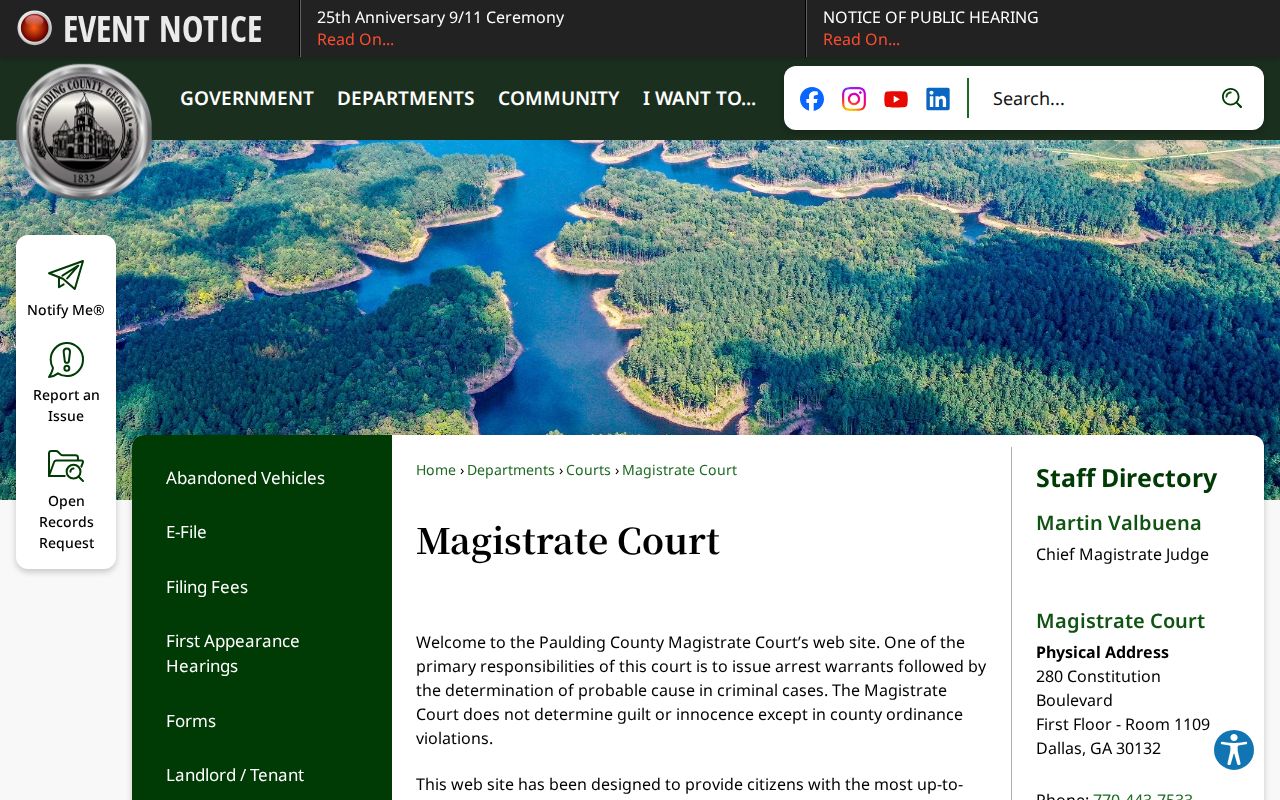
That official page names the local judicial office without showing any person-level warrant record. A judicial office issues the warrant; law enforcement handles execution. Keep that split in mind when seeking records, because a Sheriff status check and a court case request in Paulding County are not the same thing.